
📑 Table of Contents (Part I)
1. ABOUT NIMC – ESTABLISHMENT AND OBJECTIVES
1.1 The NIMC Act (No. 23 of 2007)
The National Identity Management Commission (NIMC) was established by the NIMC Act No. 23 of 2007, repealing the former DNCR law. It provides the principal legislative framework for identity management in Nigeria, supplemented by the Mandatory Use of the National Identification Number Regulations, 2017.
1.2 Functions & Powers
- Establishment of Database: Create, own, operate, and manage the National Identity Database.
- Registration & NIN Assignment: Register all registrable persons and assign a unique NIN.
- Card Issuance: Issue the General Multi-Purpose Card (GMPC).
- Harmonization: Integrate existing identity databases of MDAs (FRSC, INEC, NIS, etc.).
- Compliance Enforcement: Audits, court orders to seal non-compliant premises, and administrative fines.
1.3 NIMC Core Mandates
- Establishment and Management of the National Identity Database.
- Registration of Registrable Persons (Section 16, NIMC Act).
- Assignment of NIN as foundational digital identity.
- Issuance of GMPC.
- Harmonisation of Identity Data across MDAs.
- Authentication & Verification Services for public/private sectors.
1.4 Objectives of the Database
- Single source of truth for personal data.
- Credible demographic data for planning, healthcare, education, taxation.
- Financial inclusion via KYC for banks/fintechs.
- National security through harmonized identity databases.
1.5 Mandatory Use of NIN
| Category | Transactions Requiring NIN |
|---|---|
| Official Documents | Passport, Voter Registration, Driver's License |
| Financial Services | Bank accounts, Insurance, Tax payments, Share transactions |
| Property & Assets | Land registration, Motor vehicle purchase |
| Social Services | Pensions, Health Insurance, Adoption |
| Education | Enrollment in schools (primary to tertiary) |
| Transport & Travel | Boarding flights/trains, Purchase of travel tickets |
| Corporate/Commercial | CAC registration |
1.6 Disclosure of Registered Information
Strictly regulated: authorized access only with explicit consent. NIMC has audit powers (24 hours' notice) and can obtain court orders to seal non-compliant premises. Buying/selling NINs is a criminal offence.
1.7 Registrable Person
Section 16, NIMC Act: Citizens (including diaspora), Permanent Residents, and Long-term Residents (2+ years). Registration is compulsory within 60 days of birth.
1.8 Offences and Penalties
| Offence | Penalty |
|---|---|
| Failure to Register for NIN | 6 months imprisonment or N100,000 fine |
| Permitting Transactions Without NIN | Fines and potential sealing of premises |
| Selling or Buying NIN | Arrest, prosecution (identity theft) |
| Unauthorized Disclosure of Data | Fine or imprisonment (Section 28) |
| Tampering with Critical Infrastructure | Life imprisonment (Cybercrime Act S.16) |
2. NIMC ACHIEVEMENTS SINCE 2023 (RENEWED HOPE ERA)
Under DG/CEO Engr. Abisoye Coker-Odusote, NIMC has achieved:
- Enrollment: 72.7M (2022) → 127M+ (2025).
- Database Capacity: Expanded to 250 million.
- Processing Time: 49% reduction in NIN issuance.
- Inclusion: 206,000+ IDPs/refugees; 32,000+ inmates (85% coverage); 52% diaspora coverage.
- Integration: 125+ MDAs harmonized.
- WorkflowPro: Paperless correspondence system (Feb 2026).
- Performance Management System (EPMS): Signed October 5, 2025 with Triple Edge Consult.
3. CONDITION OF SERVICE AT NIMC
Approved by the Federal Government in September 2021, ending the poorest remuneration scheme among communications parastatals.
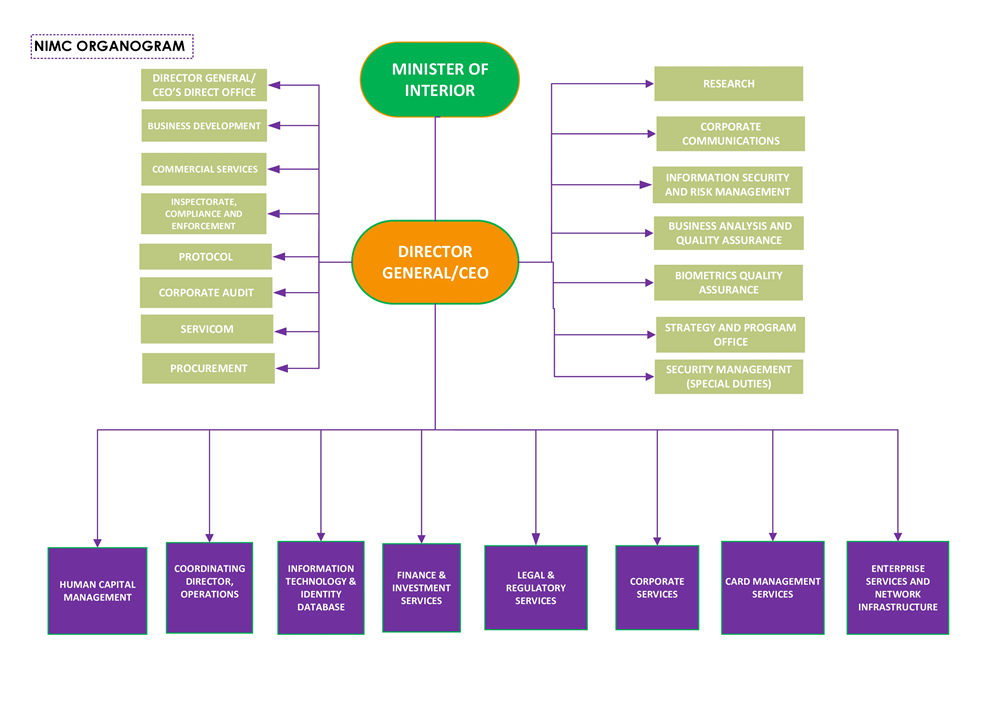
3.1 NIMC Structure & Organogram
Organizational Structure
The Corporate governance structure of the NIMC reflects government’s determination to ensure that its reform objectives are achieved. The Commission reports to the Ministry of Interior. NIMC is positioned to deliver on its mandate of establishing and regulating a reliable and sustainable national system of identity management, hence the Act provides for a Governing Board and a Functional Structure.
Governing Board
It has a governing Board consisting of the Chairman, representatives of relevant government agencies, representatives of the public and a Director General appointed by the President and is the Chief Executive Officer responsible for the day-to-day operations of the Commission.Section 2 of the NIMC Act No. 23 of 2007
- A part-time Chairman
- The Director General / Chief Executive Officer
- A representative of the Independent National Electoral Commission
- A representative of the National Health Insurance Scheme
- A representative of the Federal Road Safety Commission
- A representative of the Federal Inland Revenue Service
- A representative of the National Pension Commission
- A representative of the Nigeria Police Force
- A representative of the Nigeria Economic and Financial Crimes Commission
- A representative of the Nigeria Immigration Service
- A representative of the Office of the National Security Adviser
- A representative of the National Population Commission
- A representative of the Central Bank of Nigeria Chief of the Defence Staff
- A representative of of the Department of State Security Service
- A representative of the Corporate Affairs Commission
- Three Persons who are knowledgeable in Information Communication Technology or Identity Management to represent the public
Functional Structure
Several other units and sub-units also operate under the DG/CEO’s office and the departments.
3.2 Employment & Probation
- Eligibility: Nigerian citizen, valid NIN, 18-50 years, minimum SSCE.
- Probation: 24 months, possible 3 months extension.
- Confirmation: Satisfactory performance, good conduct, medical fitness.
3.3 Leave Types
- Annual: 21-30 days; Sick: 14 days full + 14 days half; Maternity: 4 months; Paternity: 14 days.
3.4 Promotions
Maturity Periods:- Grade Levels 05–07: Minimum of 2 years of service.
- Grade Levels 08–14: Minimum of 3 years of service.
- Grade Levels 15 and 16: Minimum of 4 years of service.
Once a staff member hits this seniority threshold, they must still pass through a competitive, performance-reward system. One cannot be promoted to the next grade level purely through the passage of time if they fail to meet the performance criteria.
3.5 Staff Discipline
Grave offences: Unauthorized disclosure of NIN data, selling/buying NINs, registration of ineligible persons, fraud. Penalties: dismissal, criminal prosecution, life imprisonment for critical infrastructure tampering.
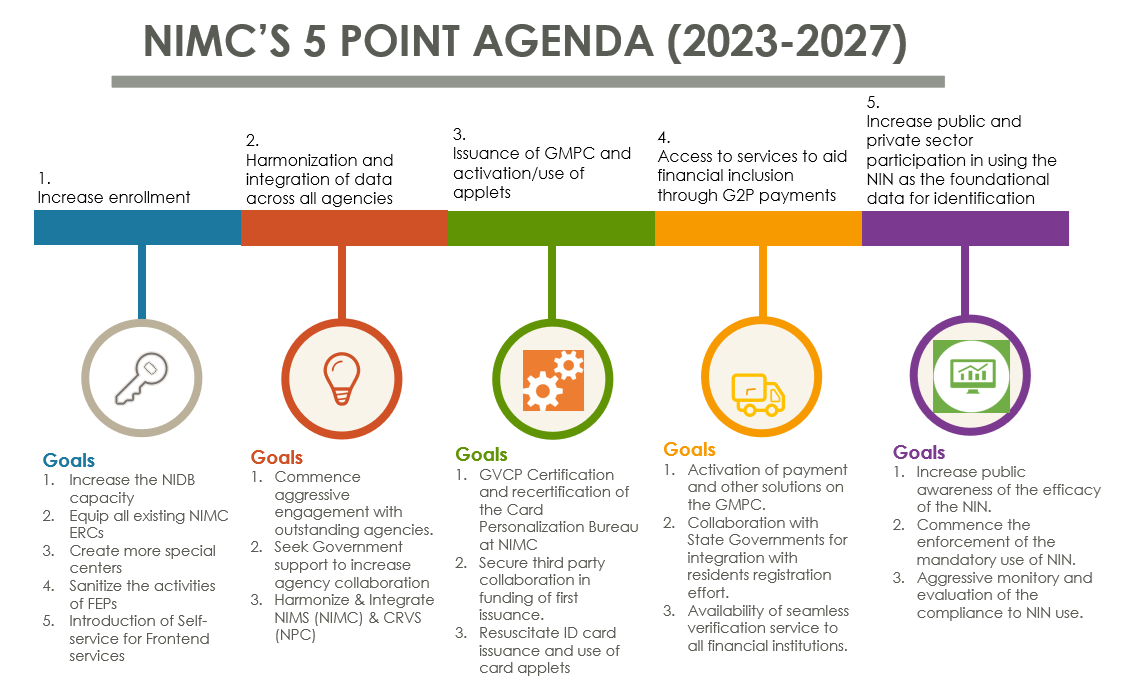
4. NIMC FIVE-POINT AGENDA
5. NIMC PRODUCTS AND SERVICES
5.1 Enrollment
- Self-Service Modification:
https://selfservicemodification.nimc.gov.ng - Pre-Enrolment Portal:
https://penrol.nimc.gov.ng - Enrollment Types: CR-NEW, ER-NEW, CR-MODIFICATION, ER-MODIFICATION, BVN-MODIFICATION.
- License Assurance Framework (LAF): Regulates Front-End Partners (FEPs).
5.2 National e-ID Card
- Polycarbonate smart card, EMV payment (Mastercard).
- Stores 10 fingerprints + iris, PKI integration.
- GMPC 2.0: Scheduled October 2025.
5.3 Authentication & Verification
- NVS: Standard identity verification (Web, API, Mobile).
- HA-NVS: 99.9% uptime, supports 3.3M daily requests.
- NINAuth: Real-time authentication app; mandated by President for all MDAs.
5.4 Harmonisation & Integration
- 125+ MDAs harmonized (CBN, NIS, FIRS, INEC, JAMB, etc.). Services integrated: bank accounts, SIM registration, passports, NELFUND loans (N86.35B disbursed).
6. NIMC SERVICE CHARTER
- Launched: August 12, 2025.
- Principles: Efficiency, Accessibility, Accountability, Professionalism.
- Target: Reduce waiting times by 30% within 12 months.
- Accountability: Quarterly performance scorecards; complaints resolved within 10 working days.
7. NIGERIA DIGITAL ID FOR DEVELOPMENT (NID4D) PROJECT
"To increase the number of persons with a National Identity Number (NIN), issued by a robust and inclusive foundational identity system."
- Coverage: All citizens, legal residents (2+ years), 774 LGAs, 8,809 wards, diaspora.
- Tenure: Extended to June 30, 2026.
- Achievements: 124M+ enrollments; MOSIP migration commenced July 2025; ISO 27001 certified.
- Identity Ecosystem: NIMC + public/private partners; 40+ real-time API integrations.
8. INFORMATION SECURITY AT NIMC
8.1 ISMS & ISO Certification
ISO/IEC 27001:2013 (upgrading to 2022) – global best practices for confidentiality, integrity, and availability.
8.2 NIMC Security Policies
- Access Control: RBAC, least privilege, MFA.
- Database Security: Encryption at rest/in transit, ABIS deduplication.
- Data Protection: Lawful processing, consent management.
- Hardening: Removal of unnecessary services, patching.
- Personnel Security: Background checks, annual training.
- Physical Security: 24/7 CCTV, biometric access.
- Incident Management: Detection → Containment → Eradication → Recovery.
- Password: 12 characters, 60-90 day expiry, MFA.
- Third-Party Access: Vendor assessments, LAF agreements.
- Change Management: Change Advisory Board approval.
8.3 Data Protection Law (NDPA 2023)
Data Subject Rights: Access, Rectification, Erasure (limited), Portability, Objection, Complaint. Breach Notification: Report to NDPC within 72 hours.
8.4 Cybercrime Act 2015
| Offence | Penalty |
|---|---|
| System Interference | Up to 3 years / N7M fine |
| Tampering with Critical Infrastructure | Life imprisonment |
| Computer Related Forgery | Up to 3 years / N7M fine |
| Unauthorized Modification of Data | Up to 3 years / N7M fine |
END OF PART I – ABRIDGED STUDY MATERIAL